Jerry Byrd (1920-2005) was a brilliant steel guitar artist who set the
standard for generations to come. Jerry invented the C6th tuning (Jerry
says it was at least 1938 on page 119 of his autobiography). He also
invented the C Diatonic tuning later on in 1952, which few steel guitar
enthusiasts are familiar with. Jerry didn't fully develop the tuning until
much later on, but he sure made some awesome recordings with it in the
1950's and 1960's. To show you what can be done with the Diatonic tuning,
check out this 1955 recording by Jerry Byrd titled, “Come
A Little Closer” (from his Hi-Fi Guitar album). Here's
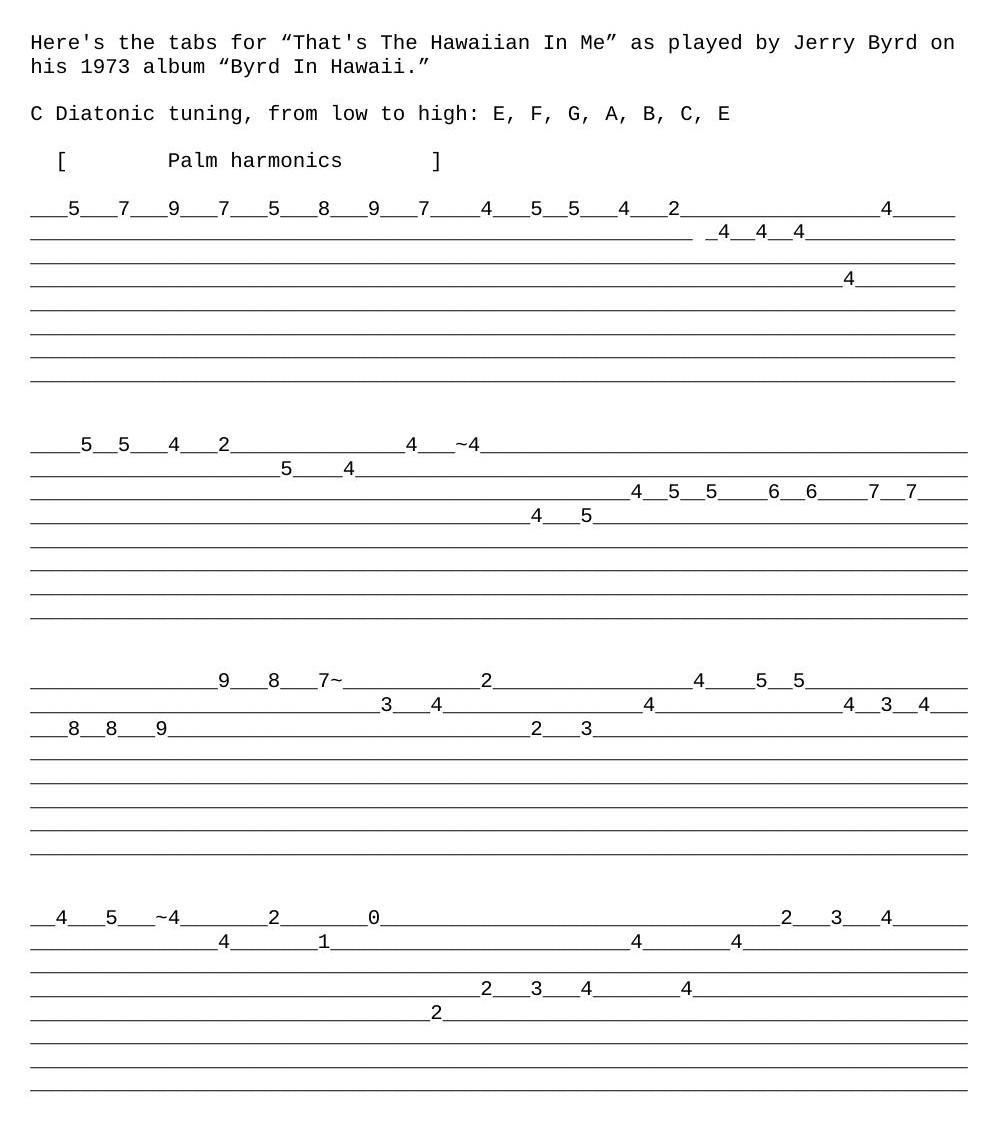
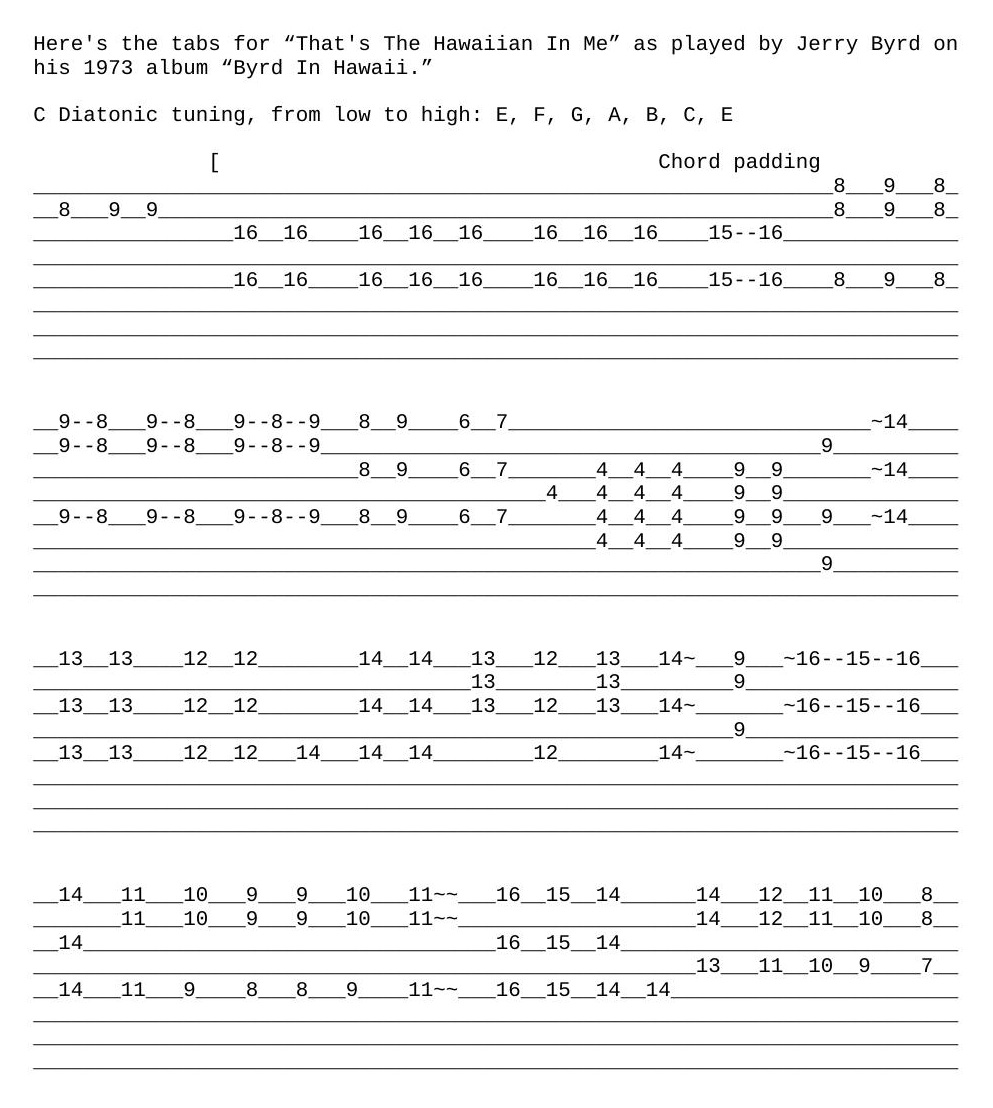
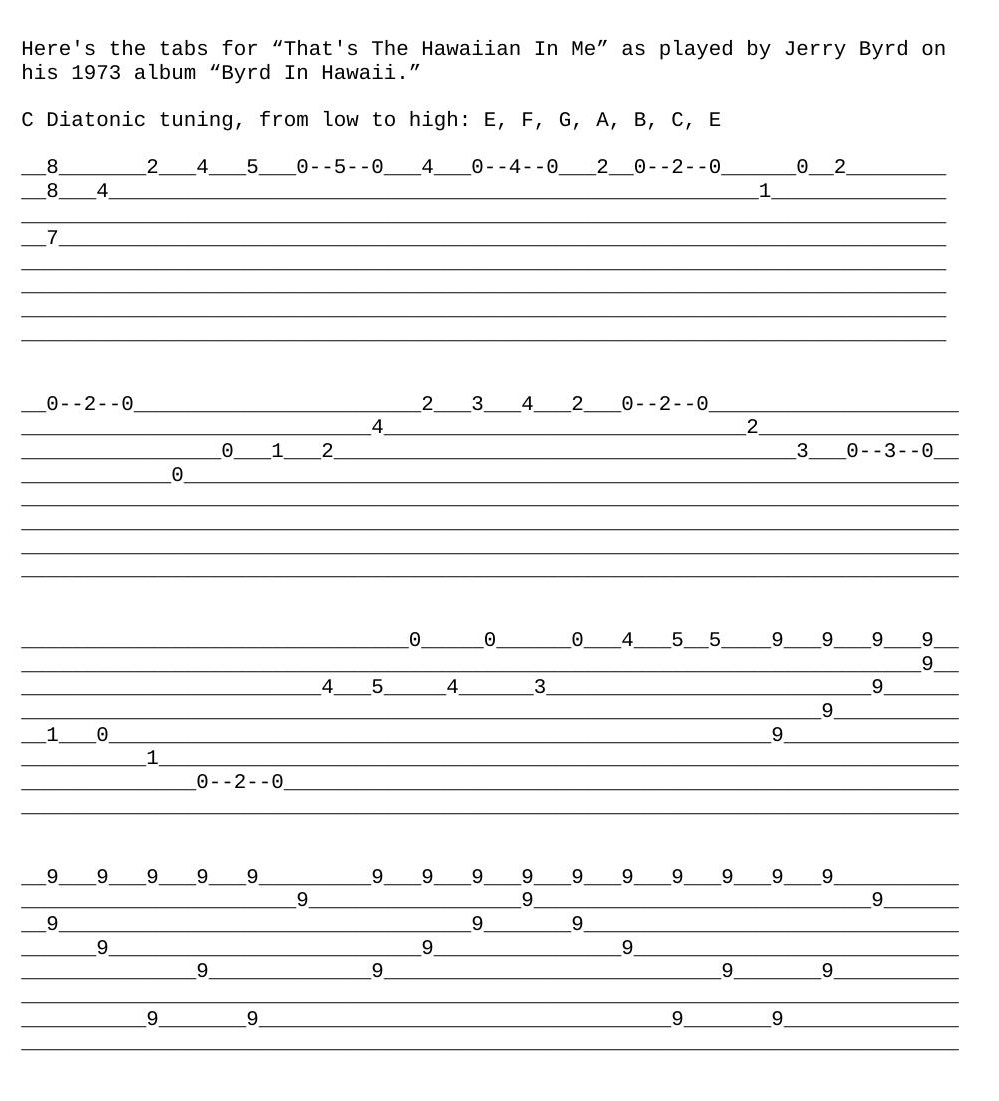
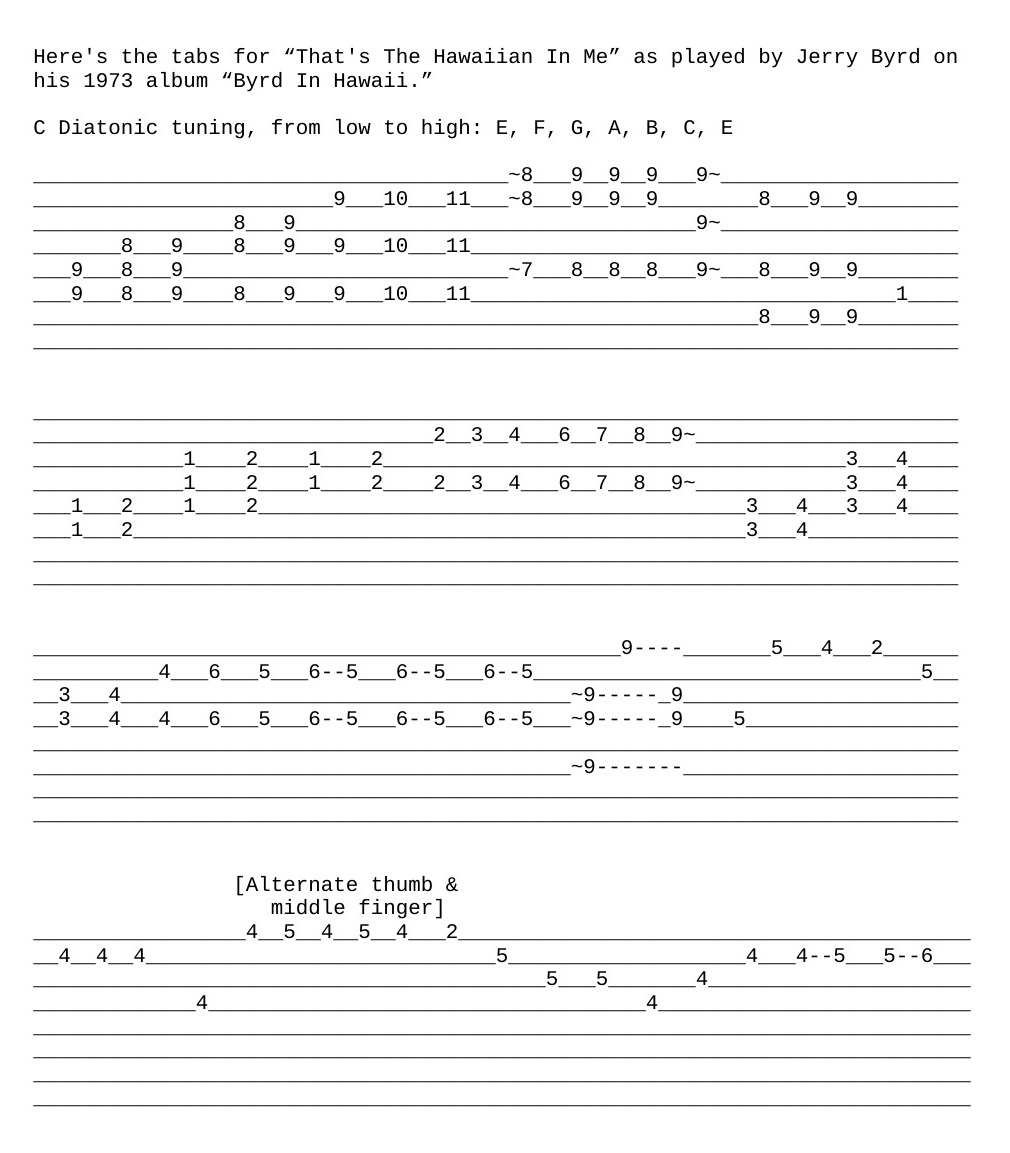
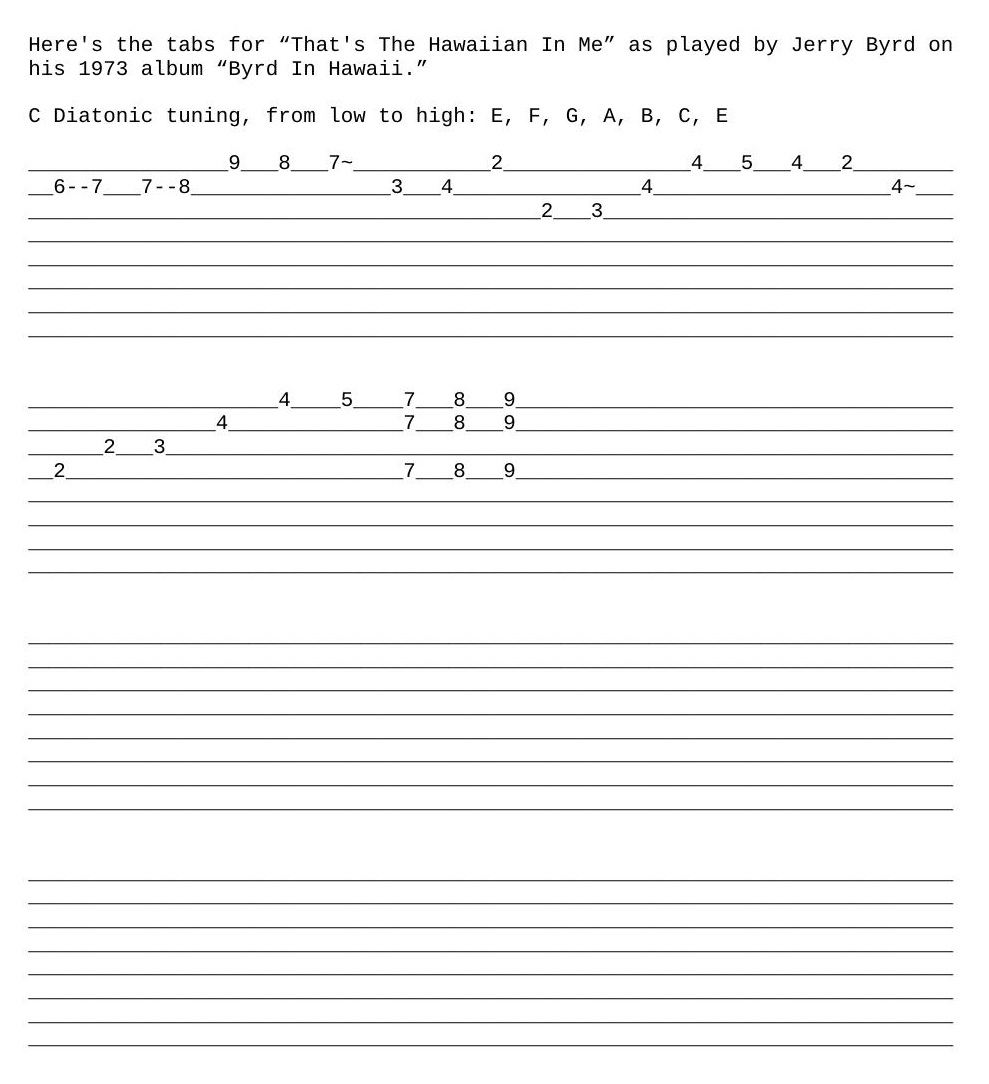
some tabs for the song! The Diatonic tuning is extremely simple to remember, just follow the alphabet for the bottom six strings (from bass to treble: E, F, G, A, B, C, E). Using this very tuning (minus the “D” note because Jerry's said it just doesn't work), he recording on the song, “Next To Jimmy” (here's the MP3) by Ferlin Husky, recorded in 1960. Wow! Great stuff! I think the C Diatonic has a pretty good feel to it, not as laidback as the C6th, but offers some great sounds if you master the techniques. I tabbed out the entire song of “That's The Hawaiian In Me” as played by Jerry Byrd on his 1973 album “Byrd In Hawaii.” C Diatonic tuning, from low to high: E, F, G, A, B, C, E. Isn't that beautiful? Jerry has impeccable bar slanting skills, which when done accurately, quickly and with your amplifier cranked up, and a decent guitar (this sounds like Jerry's 7-string Rickenbacher), it will all sound GREAT. Don't be afraid to do quick reverse bar slants. In fact, you should get into the habit of doing them as a practice scale. Jerry Byrd masterfully glides through the scales, letting it all flow seamlessly. That's all he's doing, following the melodic scales. It's not magic, just plain ole hard work and persistence. A helpful way to look at Jerry's Diatonic tuning is that it is a C6th tuning with an added 9th (D note) and 11th (F note). So you've really got a C11th tuning here. Really sweet too!
Let's use the chart above to see what chords we've got in the C Diatonic tuning. I won't tab out all the chords, because you can use the C6th chord tabs here. You got the C6th tuning below with the added 3rd and 6th string. So if you pretend that strings 3 and 6 aren't there, it the same as standard C6th. This is a really versatile tuning, if not the most... C Major C minor C9th C6th
The nice thing about standard C6th is that you can relax and just rake across all the strings; whereas with the C Diatonic you've got to work at it more (like the Bill Leavitt tuning), but you've got more to work with on the C Diatonic. It's a very beautiful and interesting tuning to say the least! Although this is not a strum tuning like the F# minor 9th tuning, it does offer a very beautiful 9th chord as heard in the previous song “Come A Little Closer.” I tried to work out the solo for “Next To Jimmy” and it requires some excellent left hand maneuvering for much of the solo, but that's why Jerry was dubbed “The Master Of Touch And Tone” in the Steel Guitar Hall of Fame. That's quite an honor, and Jerry earned it! For the solo to “Next To Jimmy” you have to do several bar slants, which aren't too difficult once you become familiar with how the tuning works. Each tuning has a different “feel” to it, which once you are comfortable with, you'll begin to excel at the tuning. I understand the C6th well, so be viewing the C Diatonic tuning without strings 3 and 6, I see why Jerry did what he did to invent this tuning. It is really an expanded hybrid C6th. I think it's great! The following helpful information is from Jerry's good friend, Ray Montee...
Jerry Byrd - 1955 Here is (in my humble opinion) Jerry Byrd's finest album which he recorded back in 1959. It is simply the most brilliant steel guitar playing I have ever heard. I want to particularly draw your attention to the song "Honolulu Eyes" which Jerry recorded using his amazing C Diatonic tuning!
|